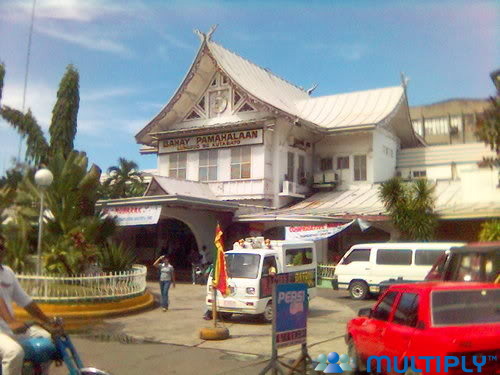
Old Cotabato City Hall
It was estrangely alluring to me to go to Cotabato City…a place evaded by many people who have no business with the place or even paranoid tourists and travelers. And speaking of paranoia, whenever this place is mentioned, fear and pessimism occupies everyone outside of Mindanao. Its a no-man’s land, or in this case, a city. Negative impressions were imprinted in this city of more than 100,000. It was the capital of the Empire Province of Cotabato, once the largest province in the counrty. A city with rich history and pride. The Stone Fortress of Mindanao.
Passing through one of the most well-paved concrete and asphalt roads in the country, the L300 zoomed passed by Isulan and moved towards no-man’s land. Sparse population, agricultural activity in contrast with a big palace in Shariff Aguak is what Maguindanao can be best described. Cotabato seemed to be so isolated from the rest of the world. Its so hard to go here honestly. Trips from Manila is less frequent than any other cities in Mindanao. Only few bus companies go to Cotabato and the main port is 15 kilometers. Roads are heavily guarded by the Army and the MILF, it does gives you the creeps whenever there are inspections that are ongoing.
Going north of the city was the heavily-bombarded Buldon-Barira area where Camp Abubakar was and to th east and south by the Tiduray Mountains and the wetlands. Cotabato City was seen to be one of the fastest growing city in Mindanao as the Land of Promise was opened for Christian Settlers from Luzon and Visayas. It was an entry port for most of the travelers who are going central.
The port teems with life as the old people say. Business transactions were being made here. Migrants from different places in the Philippines merged here along with the natives, abd because the population became so mixed, it is the only Tagalog-speaking city in Mindanao. Cotabato was far progressive from Davao City back in the 50′s.
What it seems to be a busy mecca in the south that had supposedly manifested homogenity between two age-old foes, the Christians of the north and the native Muslims and Lumads in the south, was shattered by the war that has been gearing on for generations.
It had left Cotabato isolated from the rest of Mindanao…And was left behind. Small streets which are not clogged with jeepneys and tricycles ply the city. It is hilly with a mild tropical climate. Surrounded by the two estuaries of Rio Grande de Mindanao or Pulangi, Cotabato is swampy with a hill imposing over downtown, PC Hill, where the name got its name…Kutang Bato or Kota Wato.
I went here on sembreak so I wonder how busy Cotabato is whenever there are classes in Notre Dame University and the other schools which are located in the city. Busy I guess. It reminded me of Iloilo….old yet smaller. There are only few routes for the jeepney so there is no reason why you should get lost in the city.
All “Town” jeepneys ply towards the city center which features an architectural marvel…The City Hall of Cotabato. Mixed with Spanish, American and Moro influence…Its a landmark that distinguishes Cotabato City. The main public market is all but a bustle. Although dirty, it is still full of life as compared to the gory depictions of the media. Different kinds of stuff from all over Cotabato are being sold here. The market seemed like a big jar of jellybeans…assorted with Muslims and Christians and even the Lumads.
Even though Cotabato City is the administrative center for the Autonomous Region of Muslim Mindanao, the city itself is still part of Region 12 which is Soccsksargen. The ORC is the government center of ARMM, with a museum and the office of the ARMM governor located here. Recently, Cotabato’s importance declined as the regional center was moved to a newer city of Koronadal City in South Cotabato. I was only given a day to go here as I was advised that I should be back at Tacurong befor 6PM as the roads are not safe to be traversed at night. I went to the only caves in the center of the city at the foot of PC Hill. And I went up of the Old Capitol, delapidated and needs to be renovated as it resembles architectural importance with the City Hall.
As I made myself to the top of the stone fortress, I saw the panoramic view of the city. Silent, unchaotic…Its so serene. I can’t hear the bustle that was in the downtown. Progress has been deprived ton this once important mecca. The oldest city in Mindanao at the heart of Mindanao itself. There were no malls yet, just markets. A river that runs through it. A once bustling port and a city in like an island in the middle of the sea of conflict. Cotabato City was lost in the map of the Philippines not unless stated by the media bringing bad news. It has left a negative impression on a city stuggling to move forward with peace as its banner.
As the Husky Bus whisked out of the city, I’ve seen the heart that is Mindanao, that is Cotabato, living up to its name. Cotabato, a stone fortress, dignified and standing strong amidst the sea of conflict surrounding it.
This article was first published at Habagat.i.ph and Berniemack.i.ph on September 8, 2006. It was dedicated to the people of Cotabato and to the thesis that made me look to Mindanao on a brighter perspective. Reposted from Notes from SouthCentral (www.berniemack.i.ph)


I had a project inside Camp SK Pendatun up north in Parang, Maguindanao. That hilly PNP camp has a commanding view of Polloc seaport and the bay. It has the same awesomeness as being in Tagaytay plus it’s more quiet. The camp itself is a hidden tourist attraction with its varied topography and abundance of decades-old trees. It has a 9-hole golf course, a tennis court, and used to have its own bowling lanes and other recreational facilities from 1970s to 80s. Too bad it’s hard to go there.
By the way, the only local specialty I tried there is the pastel. It’s sticky rice with chicken chunks inside. It’s halal and supposed to be a complete meal on the go.
[WORDPRESS HASHCASH] The poster sent us ’0 which is not a hashcash value.
I hope I can go there someday. It’s the lack of time and money that hindered me exploring some areas of Mindanao and not the fear of terrorism or atrocity.